


Disclosure. TruNova implements Dynamics 365 Business Central. We have a horse in this race, so we have worked to be fair about where Acumatica is the better call. If one ERP won every deal, comparisons like this would not exist.
Business Central and Acumatica are both good mid-market cloud ERPs. That is the honest starting point, and it is where most comparisons quietly cheat, by pretending the other product is weak. It is not. The real question is not which is better. It is which is better for a specific company, with a specific team, running specific software already.
This walks the differences that actually change the decision, names where each one wins, and lands on a recommendation for the kind of company we work with most. Pricing and features move, so treat the numbers here as current-era figures to verify with each vendor, not gospel.

The one difference that drives everything: the pricing model
Most of the practical difference between these two comes down to how they charge, because that shapes who each one suits.
-
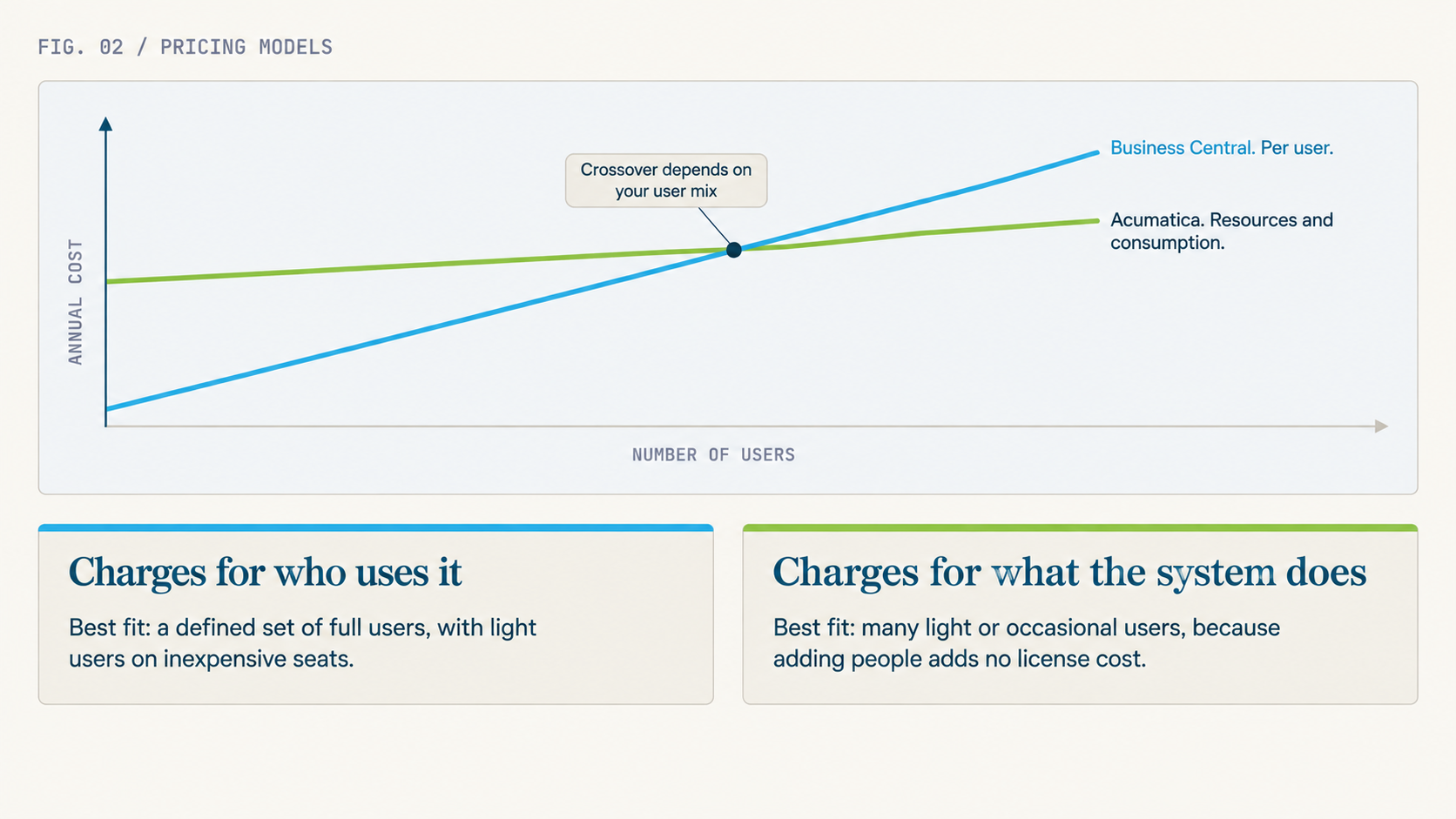
Business Central charges per user. Essentials runs about $80 per user per month and Premium about $110, with lightweight Team Members around $8 per user per month, all billed annually. These are current figures after Microsoft’s late-2025 increase, so confirm the latest before you budget. Cost scales with the number of full users.
-
Acumatica charges by resources and consumption. You pay for the applications you license and a transaction volume tier, and users are effectively unlimited. Entry-level pricing starts in the range of $6,000 to $7,000 per year, with many mid-market deployments landing roughly $25,000 to $75,000 per year depending on modules and transaction volume.
That single design choice decides a lot. A company with a large population of light or occasional users, shop floor staff, field technicians, warehouse workers, tends to do well under Acumatica’s unlimited-user model, because adding people does not add license cost. A finance-led company with a defined set of full users often lands simpler and cheaper on Business Central, especially when light users sit on the inexpensive Team Members license.
Acumatica charges for what the system does. Business Central charges for who uses it. Count your users before you compare anything else.
Where Acumatica is genuinely strong
A fair comparison has to say this plainly. Acumatica is a serious product, and there are companies for which it is the right answer.
-
The unlimited-user model is a real advantage when you have far more occasional users than full finance users. It removes the per-seat math that can make Business Central expensive at high headcount.
-
Customer satisfaction runs high. In independent review aggregators, Acumatica frequently scores at or above Business Central on ease of use and overall satisfaction. That is worth taking seriously, not explaining away.
-
Strong industry editions. Acumatica has invested heavily in verticals such as construction, distribution, manufacturing, and field service, with workflows built for those trades rather than bolted on.
-
Deployment flexibility. Acumatica supports a range of deployment and hosting choices, which matters to organizations with specific data-residency or infrastructure requirements.
Where Business Central pulls ahead
-
It lives inside Microsoft. If your company already runs on Microsoft 365, Business Central is home turf. It works natively with Excel, Teams, Outlook, Power BI, Power Automate, and Power Apps, and it connects cleanly to Dynamics 365 Sales. For a Microsoft-centric organization, that integration is not a feature list, it is daily friction removed.
-
The AI and platform story is deeper. Copilot is embedded across Business Central, and it sits on the Power Platform for automation and low-code extension. Acumatica’s native generative AI is thinner today, and its longer-term innovation roadmap is less clear.
-
The ecosystem lowers your risk. Business Central has a very large partner network, a deep catalog of ISV apps on Microsoft AppSource, and the long-term backing of Microsoft. That breadth means more implementers to choose from and less vendor concentration risk.
-
The finance and reporting foundation is strong. The chart of accounts, dimensions, Financial Reports, and the Excel and Power BI reporting stack give a finance-led team a lot of depth when the structure is designed well. That is the entire subject of our chart of accounts series.
An honest decision framework
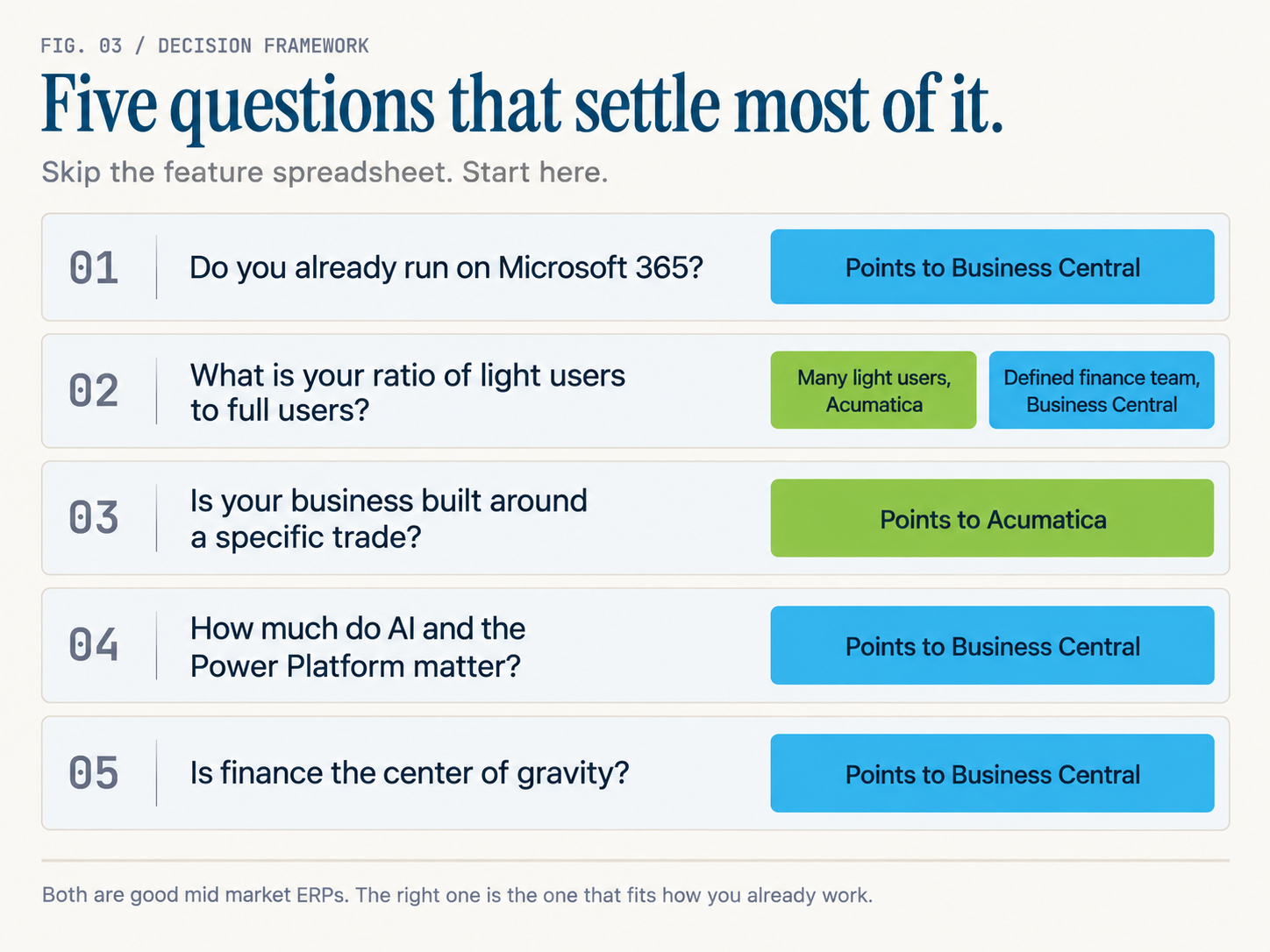
Skip the feature-by-feature spreadsheet. A handful of questions settle most of these decisions.
-
Do you already run on Microsoft 365? If yes, Business Central starts ahead on integration and familiarity.
-
What is your ratio of light users to full users? Many occasional users and few finance users tilts toward Acumatica’s unlimited model. A defined finance team with light users tilts toward Business Central with Team Members.
-
Is your business built around a specific trade? If construction, field service, or a project-heavy model is your core, weigh Acumatica’s industry editions seriously against Business Central plus a specialist ISV.
-
How much do AI and the Power Platform matter? If embedded AI and low-code automation are part of your plan, Business Central is further along.
-
Is finance the center of gravity? If reporting depth and financial structure lead the decision, Business Central’s finance stack is a strong fit.
Our take
For the company we work with most, a Microsoft-centric, finance-led mid-market business, Business Central is usually the better long-term home. It sits inside the tools the team already uses every day, the reporting foundation is deep when it is designed with intent, and Microsoft’s investment lowers the long-term platform risk. That is our honest read, and yes, it is also our practice.
Acumatica is a real contender, not a straw man. If you have a large light-user population, or your business lives in a vertical where Acumatica’s industry edition is clearly ahead, it can be the smarter buy, and we would rather tell you that than sell you the wrong fit. Anyone who claims one ERP wins every deal is selling, not advising.
The right ERP is not the one with the longest feature list. It is the one that fits how your business already works and how you want it to report.
Whichever way you lean, verify current pricing and module details directly with each vendor before you decide, because both move their numbers. And if you land on Business Central, the reporting foundation is what makes or breaks the result. Our chart of accounts series is where that starts.
Figures are current-era estimates gathered from public pricing and comparison sources and are subject to change. Verify with each vendor before deciding.